







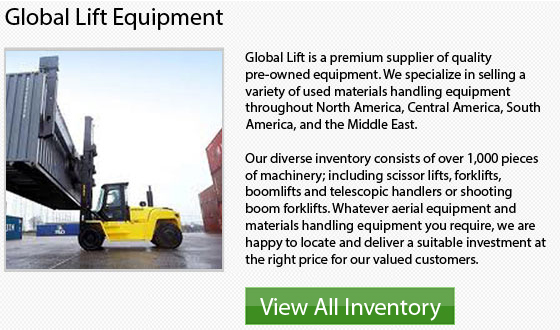
A telescopic handler is similar to a forklift. It has one telescopic boom that extends upwards and forwards from the truck, and a counterweight in the back. It functions more like a crane than a forklift. The boom can be outfitted with different kinds of attachments. The most common attachment is pallet forks, but the operator could also attach a muck grab, lift table or bucket. Also referred to as a telehandler, this particular kind of machine is normally utilized in industry and agriculture.
A telehandler is often utilized to move loads to and from areas that would be difficult for a standard forklift to access. Telehandlers are normally used to unload pallets from inside a trailer. They are also more practical compared to a crane for carrying loads onto rooftops and other high places.
There is just one major limitation in utilizing telehandlers. Despite counterweights at the rear, the weight-bearing boom could cause the machine to destabilize as it extends. Therefore, the lifting capacity decreases as the distance between the front of the wheels and the centre of the load increases.
The Matbro company developed telehandlers in England. Their design was based on articulated cross country forklifts used in forestry. First models had a centrally mounted boom on the front and a driver's cab on the back section, but these days the design which is most popular has a rigid chassis along with a side cab and rear mounted boom.